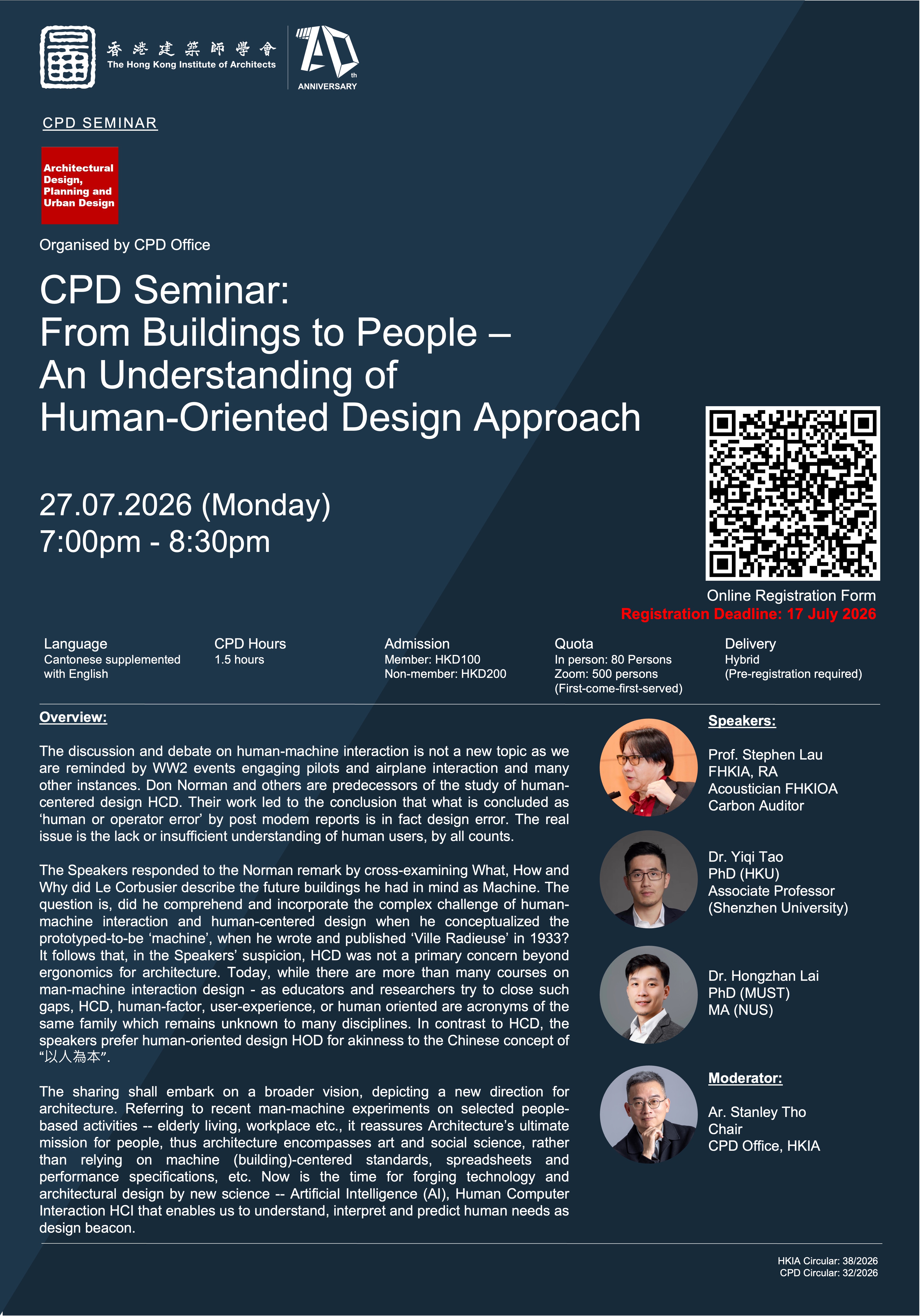

CPD Seminar: From Buildings to People – An Understanding of Human-Oriented Design Approach
Date: 27 July 2026
[Event Recap]
We are delighted to share the successful launch of our latest HKIA CPD event, featuring an insightful research sharing by Professor Stephen Lau, themed From Building to People - an Understanding of Human-Oriented Design Approach.
Against the backdrop of Hong Kong’s recent enactment of the Building Amendment Regulation, which introduces mandatory design provisions catering to elderly care needs in the built environment, our CPD Chair would like to echo the cross-professional commitment towards fostering longevity, public health and holistic wellbeing across our built industry.
Professor Stephen Lau’s CPD presentation arrives as a perfectly timely response to pressing social demands. Moving architectural practice beyond conventional aesthetic benchmarks and statutory compliance frameworks, his human-centric research unpacks how designers can deepen their work to prioritise occupants’ psychological comfort, nuanced sensory experiences, and adaptive living requirements, recalibrating our built environments to truly centre human needs.
Rather than delivering a fixed set of definitive conclusions or prescriptive rules, this sharing opened up rich avenues for collective discussion, inviting fellow practitioners to rethink what metrics we observe, and which critical lenses designers ought to embed within their daily design decision-making.
It was truly a deeply informative, thought-provoking evening for all attendees. Grateful to Professor Stephen Lau for his invaluable expertise, and to every participant who joined this meaningful exchange of ideas.
#HKIA #HKIACPD #HumanCentredDesign #ElderlyFriendlyDesign #BuiltEnvironment #AgeFriendlyHongKong #ArchitecturalResearch #WellbeingDesign
**************************************************************************************************************************************************************
CPD Seminar: From Buildings to People – An Understanding of Human-Oriented Design Approach
Date: 27 July 2026 (Monday)
Time: 7:00pm - 8:30pm
Language: Cantonese supplemented with English
CPD Hours: 1.5 hours
Admission: Member: HKD100; Non-member: HKD200
Quota: In person: 80 Persons; Zoom: 500 persons (First-come-first-served)
Delivery: Hybrid (Pre-registration required)
Registration: https://forms.office.com/r/uSpgYGXTe2
Overview:
The discussion and debate on human-machine interaction is not a new topic as we are reminded by WW2 events engaging pilots and airplane interaction and many other instances. Don Norman and others are predecessors of the study of human-centered design HCD. Their work led to the conclusion that what is concluded as ‘human or operator error’ by post modem reports is in fact design error. The real issue is the lack or insufficient understanding of human users, by all counts.
The Speakers responded to the Norman remark by cross-examining What, How and Why did Le Corbusier describe the future buildings he had in mind as Machine. The question is, did he comprehend and incorporate the complex challenge of human-machine interaction and human-centered design when he conceptualized the prototyped-to-be ‘machine’, when he wrote and published ‘Ville Radieuse’ in 1933? It follows that, in the Speakers’ suspicion, HCD was not a primary concern beyond ergonomics for architecture. Today, while there are more than many courses on man-machine interaction design - as educators and researchers try to close such gaps, HCD, human-factor, user-experience, or human oriented are acronyms of the same family which remains unknown to many disciplines. In contrast to HCD, the speakers prefer human-oriented design HOD for akinness to the Chinese concept of “以人為本”.
The sharing shall embark on a broader vision, depicting a new direction for architecture. Referring to recent man-machine experiments on selected people-based activities -- elderly living, workplace etc., it reassures Architecture’s ultimate mission for people, thus architecture encompasses art and social science, rather than relying on machine (building)-centered standards, spreadsheets and performance specifications, etc. Now is the time for forging technology and architectural design by new science -- Artificial Intelligence (AI), Human Computer Interaction HCI that enables us to understand, interpret and predict human needs as design beacon.
Speakers:
Prof. Stephen Lau
FHKIA, RA
Acoustician FHKIOA
Carbon Auditor
Dr. Yiqi Tao
PhD (HKU)
Associate Professor
(Shenzhen University)
Dr. Hongzhan Lai
PhD (MUST)
MA (NUS)
Moderator:
Ar. Stanley Tho
Chair
CPD Office, HKIA